
EXECUTIVE BOARD

Click here for List of Executive Board and Directors

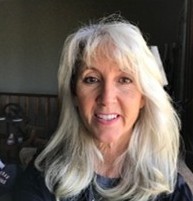
A Message from Michelle Curry, President

Michelle Curry, President of Ocala Art Group

On Pricing Your Art
as an Artist.

“Investing in art is investing in human soul and story.” 
-Henry Ward Beecher

“When Bankers get together for dinner, they discuss art. When artists get together for dinner, they discuss money.”

At some time or another as an artist, usually about the time you begin showing your art, you come up with the quandary about how to price your work.

This is not an easy task. I remember years ago. It took me at least a year of research to decide how to start pricing my artwork to sell. This is part of the life journey of being an artist.

There are a few strategies to do this.  

1. The Arbitrary method. With this one, you just decide how much you want to charge for your work. It can be based on emotion, how attached you are to the piece, how hard or complex it was to make, or changed depending on where you are showing it (maybe in a fancy locale or venue). I have even seen it to where artists who do not want to sell their piece, put a high price on it, hoping that it won’t sell! 😉

2. The Hourly Rate Method. On this one, you decide an hourly rate you want to charge. You keep track of the time it takes you to make the artwork, and that is what you charge! The problem with this method is that art very often takes a long time to make, or is unpredictable. Some people who do more crafty or utilitarian types of things (ex. pottery, or basketry) might be able to price their work this way, as they know how long it takes to produce the same kind of item.

3. The Price Per Square Inch Method. With this kind of pricing strategy, you are pricing your work as a commodity using per unit measure. This method makes your pricing consistent regardless of where you show, how long it took you to create the work,  or how emotionally involved you are in the art piece. This method is also advantageous as it creates a consistent pricing structure that over time garners trust with your collectors. 

Whichever method that you choose, there are some other things to take into consideration.

You must do Market Research in the area where you are selling. Tour galleries, artist studios, go to shows, look at where art is sold on the internet. Look anywhere original art is sold. Particularly, the location of where you want to sell. (Location, location, location)! Look at the kind of art that is displayed and how it relates to your style. (Ex: If you are a landscape artist, and specializing in watercolor, look at other artists’ work whose work is similar to yours). What are they charging for their work? Take into consideration that In a particular location, good work may not garner the same prices as in, say, an ocean front gallery, catering to tourists. How much consistent work do they have that is priced similarly? Be objective and discerning in that when you evaluate their work, ask yourself, are they they more skillful, or is my work more advanced than theirs? You want to see many artist’s works to develop a true evaluation, and get an objective view of the market.

Anorher thing to evaluate is a Experience Comparison. If you get a chance, read the artist’s bio, and find out the education that they have had to be able to create their works. This may or may not be something that is important, but in general, those who have trained, and honed their craft and workmanship, and have worked long in the art field, has the work that shows it. Also,  if they have been a long time in the market, and have a large following, that will be hard to emulate if you are just starting out.

Have consistency when you set your prices privately for showing,  whether it is in your home studio, or when in a formal professional gallery, (that may have exclusivity rules and clauses). Many artists have found this out the hard way, when their gallery found out that they under-priced and sold their work, when they had a prohibitive contract. If you are consistent  with your business, it avoids issues later on!

if you are planning on showing in a gallery, you will be dealing with a sales commission, as most if not all galleries can and do charge sometimes up to forty to fifty percent on a sale. You need to consider this in your pricing strategy. 

You must figure out your general materials cost.That may include artist quality pigments, substrates, gold leaf, etc. used to make your art. Another important thing to consider is the framing, and if your art needs matting, and uv glass. 

Take all this in, so that when you eventually sell an art piece, you don’t lose your shirt! You may not get your time out, but it is important to properly give a valuation of your art work, both for yourself as a professional, your clientele, and your fellow artists.

If you are in this for the long haul, at a semi-professional level, it is advisable that once you figure out your price strategy, not to change it up or down. Be sure of what you are doing, and why, and stand on it. People will come and question it, but don’t let it sway you. If you do the research, and put a lot of objective thought into this, then you must be ready to hold the set strategy. Art sells slowly in general, so you should be consistent, and only change your pricing strategy, as you begin to sell out!

Do due diligence. Document and photograph your artwork, and keep records. You own the copyright, by virtue of being the creator of original work (but the burden of proof is on you). Create a reciept,  and retain a copy. Charge the going rate of sales tax, and record it when you do your business taxes. This protects you, and your buyer’s investment in purchasing your art!

I would like to give you an easy answer on how to price your work, but each art business is as different as each individual is unique! 

I hope this has been helpful in crafting your own strategy to fit your needs! I hope that you sell your beautiful work, and wish you all the best success in your art and business this, and years to come!

Happy ARTing!
Michelle Curry
OAG President
Artist, Educator

Incoming officers: President Michelle Curry, VP Marilyn Busse, Treasurer Cathy Burnside, Recording Secretary Cheryl Dornbush (absent), and Corresponding Secretary Linda Bakos. Huge shout-out to these brave volunteers! For a full review of the event and more photos, continue here.
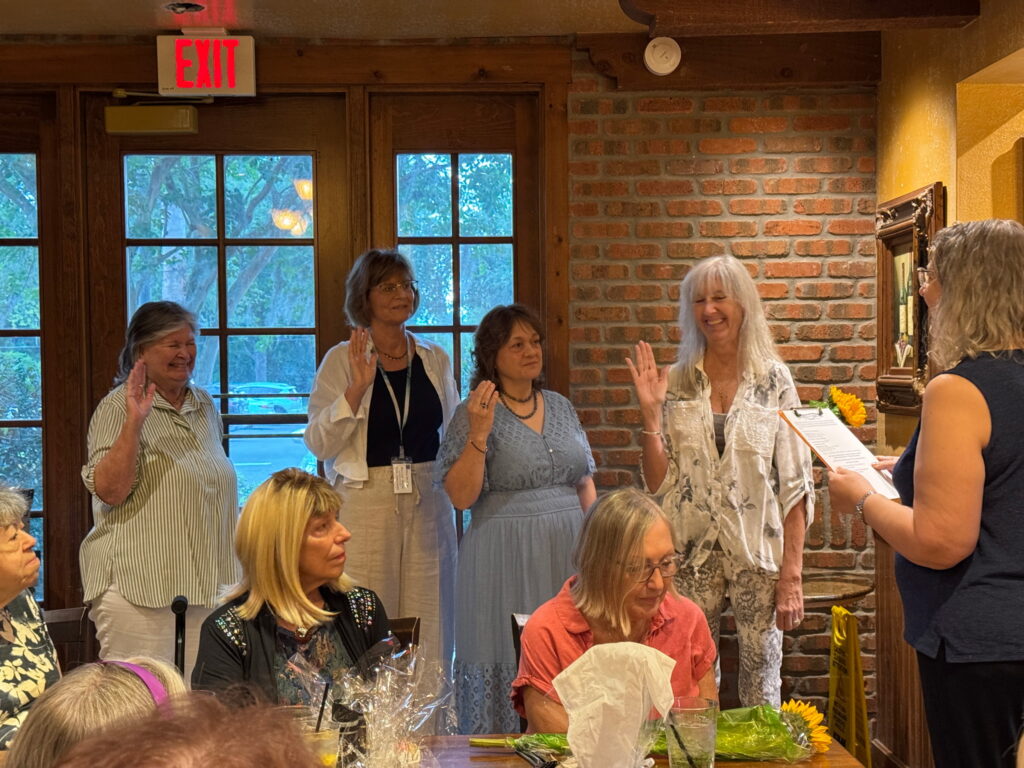
Installation of Officers

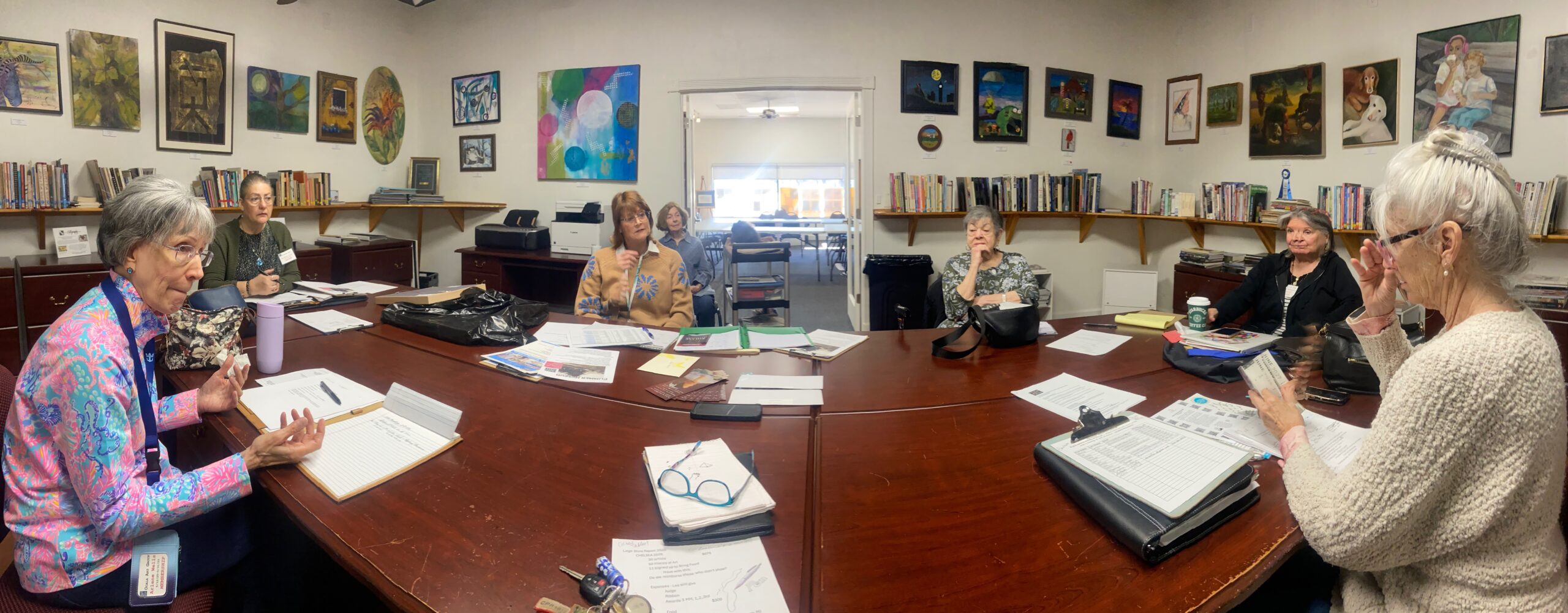
Executive Board- Panoramic View- January 2026- photo contributed by John D. Elliott

OCALA ART GROUP EXECUTIVE BOARD & DIRECTORS

OFFICERS 
(* Voting rights)
President*Michelle Curry
1st Vice President of Exhibits*Monica Coburn
2nd Vice President of Programs*Marilyn Busse
Recording Secretary*Cheryl Dornbush
Corresponding Secretary*Linda Bakos
Treasurer*Cathy Burnside
Past President*Lee Asta
COMMITTEE CHAIRPERSONS
Membership*Arlene Wells
Community Outreach*
Social Media and Website*Barbara Fife, Catherine Burnside,
John Elliott
Notices- MailchimpCheryl Dornbush, Catherine Burnside
Publicity*John Elliott